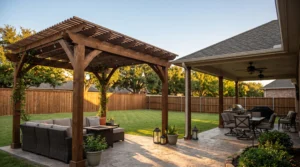
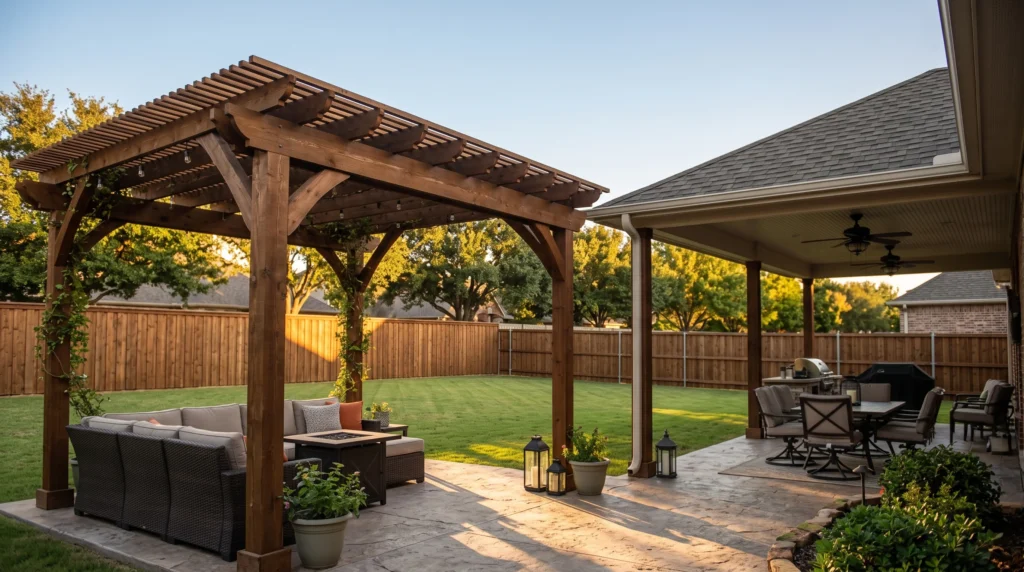
Choose a pergola if you want filtered shade, open airflow and a defined outdoor space, and choose a solid-roof patio cover if rain protection and more consistent shade matter most. Both can work in North Texas, and the better fit depends on how you plan to use the space, how it connects to your house, and what your city and HOA allow.
Homeowners in Plano and North Dallas often ask this question when summer heat makes a bare patio hard to use. This guide is a decision aid, not a sales pitch. It explains the practical differences so you can ask better questions before you commit.
Key Takeaways
- A pergola typically has an open top that filters light. A solid-roof patio cover is designed to block more sun and shed rain.
- Attached and freestanding structures raise different questions about how they connect to the house, drainage and footings.
- Airflow and light work against each other. More coverage usually means more shade and less open feeling.
- Material choice affects upkeep. Ask what maintenance each option needs over time.
- City permits and HOA rules vary by location. Check with the specific city and association rather than relying on a general answer.
What Is the Difference Between a Pergola and a Patio Cover?
A pergola is generally an open-frame structure with beams or slats overhead. It casts patterned shade and defines a space but typically does not keep rain out unless a covering is added. A patio cover has a solid or closed roof, so it is designed to shade more completely and to keep rain off the space beneath it.
In practice, products blur the line. Adjustable louvers, add-on canopies and different roof materials mean some structures sit between the two. That is why describing what you want the space to do is more useful than choosing a label.
Should the Structure Be Attached to the House or Freestanding?
An attached structure connects to the house, often over a patio or deck beside the back door. That can make the space feel like a continuation of the home. It also raises questions about how the structure is fastened, how water drains where the roof meets the wall, and how it affects the existing roofline or siding.
A freestanding structure sits on its own footings and can go anywhere in the yard, such as beside a pool or in a corner. It avoids connecting to the house but needs its own support, and placement may be affected by setbacks and property lines. Neither option is automatically better. The right choice depends on your layout and your goals.
How Much Sun and Rain Protection Do You Actually Want?
Think about when you will use the space. If it is mostly for summer evenings, filtered shade may be enough. If you want to cook, dine or sit outside after a spring shower, a solid roof may matter more. Consider where the sun hits during the hours you will use the space, since North Texas summer afternoons can be intense and direction matters.
We are not making claims about energy savings or cooling-bill reductions, since those depend on many factors and we have no verified data. What we can say is that more overhead coverage generally means more shade and less open sky.
How Does a North Texas Summer Change the Decision?
Summer use is the reason most homeowners here want shade in the first place, so it is worth picturing a real July afternoon. Which direction does the patio face? Does the afternoon sun hit it directly? Is there a tree that already provides some shade, and will it still be there in five years? These questions can matter more than the style of the structure.
Wind and storms matter too. North Texas weather can include strong gusts and severe storms, and any overhead structure should be designed and anchored with that in mind. Ask a builder how the structure is secured and what it is designed to handle, rather than assuming every option performs the same.
Finally, think about the seasons outside summer. A solid cover may make a space more usable on a drizzly day, while an open pergola may let in welcome winter sun. We are not promising year-round comfort from either one, but picturing how you would use the space across the year helps you pick one that fits your habits.
How Do Airflow, Light and Upkeep Compare?
A solid roof can make a space feel more enclosed, and depending on its design may hold heat or limit breeze. An open pergola lets air and light through, but it also lets more sun in. Upkeep varies by material: wood generally needs periodic sealing or staining, while other materials have different care requirements. Ask for specifics on whatever material you are considering, and think about whether you will realistically do the maintenance.
Pergola vs. Patio Cover: Side-by-Side Comparison
| Factor | Pergola (typical open design) | Solid-roof patio cover |
|---|---|---|
| Shade | Partial, filtered shade | More complete shade |
| Rain protection | Limited unless a covering is added | Designed to keep rain off the space |
| Airflow and light | More open and brighter | Can feel more enclosed |
| Attachment | May be attached or freestanding | Often attached, may be freestanding |
| Drainage | Less roof runoff to manage | Roof runoff needs a planned path |
| Upkeep | Depends on material | Depends on material and roof finish |
| Permits / HOA | Varies by city and association | Varies by city and association |
What About Footings, Drainage and Fit With Your Deck or Patio?
Any overhead structure needs to be supported properly. Footings, post placement and attachment details are engineering and local-code questions, and the answers depend on the structure, the soil and the city. Ask any builder how the structure will be supported and how water will be managed, especially where a roof meets the house.
Consider how the structure fits the space beneath it. If you already have a deck or are planning one, the two should be designed together. Our post on why you should size up a new deck covers deck size and design in detail.
What Should You Ask a Builder Before You Choose?
- How will the structure be attached, or supported if it is freestanding?
- How will rainwater from a solid roof be directed away from the house and the patio?
- Which materials are available, and what upkeep does each one need?
- Who is responsible for permit applications and any HOA submissions?
- How will the structure work with my existing deck or patio, or one I plan to build?
- What is included in the estimate, and what would change the price?
Written answers to the same questions from each builder make options much easier to compare, and they show you who has thought carefully about your particular yard.
Do You Need a Permit or HOA Approval?
Often there are requirements, but they are not the same everywhere. Permit rules are set by each city, so Plano, Frisco, Allen and McKinney can differ, and there is no single Collin County-wide answer. The City of Plano posts permit information for residential projects. If you have an HOA, ask whether it requires approval for structures, materials, colors or placement before you spend money on design.
How Do You Narrow Down the Choice?
If you are still undecided, try a simple exercise. Write down the three things you want most from the space, such as shade at dinnertime, a spot that stays usable after rain, or a bright and airy feel. Then check each option against that list. The structure that satisfies the most important items is usually the better fit, even if another looks nicer in a photo.
It can also help to visit neighbors or friends who have each type and ask how they use it day to day. Real-world experience in your own part of North Texas often says more than a product description.
Frequently Asked Questions
Can a pergola keep the rain out?
An open pergola generally does not, unless it includes a roof, canopy or other covering. If rain protection is a priority, ask about options designed for it.
Is a patio cover always attached to the house?
No. Many are attached, but freestanding options exist. Placement depends on your layout, local rules and what you want the space to do.
Do I need approval before building either one?
It depends on your city and neighborhood. Check with the city and, if you have one, your HOA before finalizing plans.
Thinking About Shade for Your Backyard?
If you are comparing options for your patio or yard, Sonova Construction can talk through what might fit your property. See our exterior work page, then contact us or call 972-777-3727.