A fence is one of those projects that seems simple until you’re actually pricing it out: which style, how tall, does the city or your HOA even allow what you want, and how much more does real privacy actually cost. If you’re planning a new fence anywhere in the DFW Metroplex, here’s how to think through the two biggest decisions, style and height, and why homeowners across North Texas call Sonova Construction to get it built right the first time.
Board-on-Board vs. Traditional: What You’re Actually Paying For
A traditional wood privacy fence (sometimes called stockade) sets vertical pickets side by side in a single layer along the rails. It’s the most common and most affordable style, but as the wood ages and naturally shrinks, small gaps open up between boards, gaps that let light, sightlines, and eventually sound through.
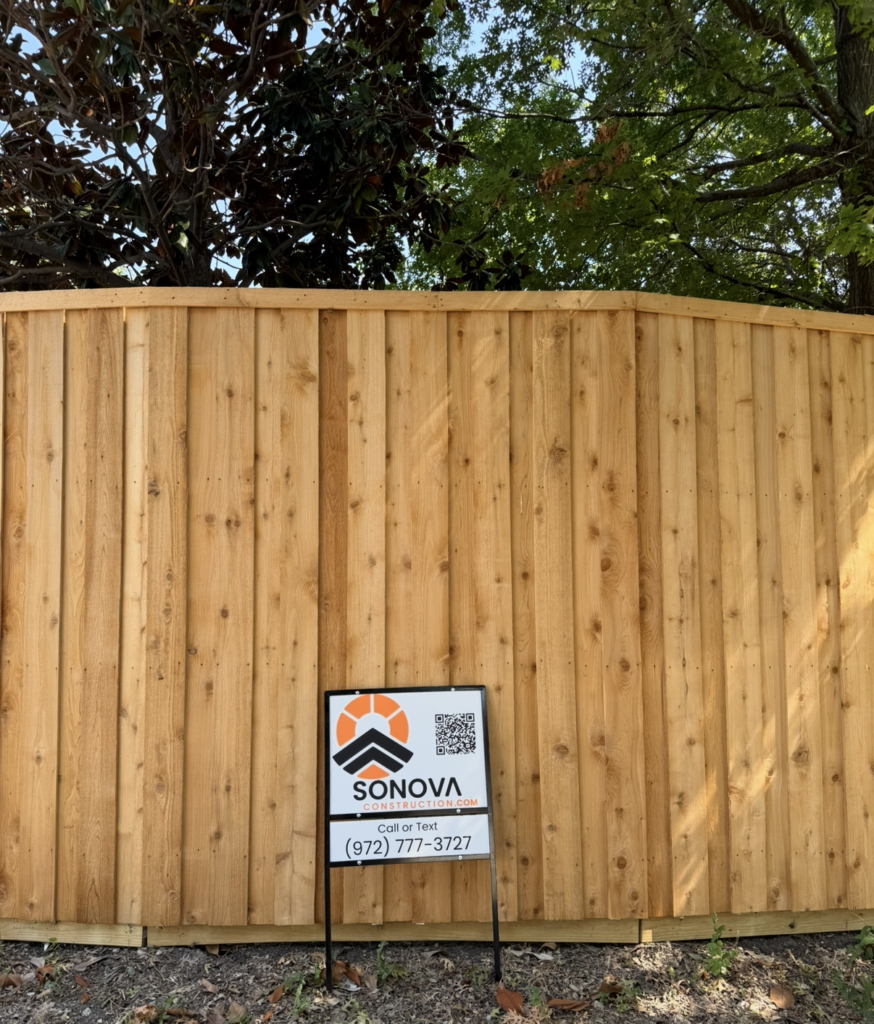
Board-on-board fencing solves that problem by design. Pickets are installed in two overlapping layers, staggered on alternating sides of the rail so each gap in the front layer is covered by a board in the back layer. That overlap means no sightline gaps now or after the wood shrinks with age, which is why board-on-board is the standard choice for backyards with pools, hot tubs, or homes close to a neighbor. It also looks identical from both sides of the fence line, so neighbors on either side get the same finished appearance, which matters more than people expect when a shared fence goes up.
The tradeoff is cost. Because board-on-board requires roughly 30 percent more lumber than a single-layer traditional fence to create the overlap, it typically runs noticeably higher per linear foot, often in the range of $28 to $52 per foot installed depending on wood species, versus roughly $15 to $35 per foot for a standard traditional fence. For homeowners who don’t have a direct sightline issue, a traditional fence is often the more budget-conscious choice. For anyone prioritizing full privacy, especially around a pool or a tight lot line, board-on-board is worth the difference.
6 Feet or 8 Feet: Height Changes More Than the View
Six feet is the standard privacy fence height across most North Texas neighborhoods, and for good reason. It blocks nearly all direct eye-level sightlines from a neighboring yard or street, it’s the most common height allowed without extra city review, and it keeps material and labor costs on the lower end, generally under 10 percent more than a shorter fence in most cost models.
Eight feet makes sense in more specific situations: corner lots with more exposure, homes backing to a busier street, raised patios or pools where a taller fence is needed to block sightlines from elevated angles, or properties near two-story homes where a neighbor’s upstairs windows look directly into the yard. The tradeoff is real. An 8-foot fence costs meaningfully more, commonly 20 to 25 percent above a 6-foot fence of the same material and length, and it requires deeper post footings and stronger bracing to handle North Texas wind loads. It’s also far more likely to trigger a city permit requirement or run into an HOA height cap, since most DFW jurisdictions treat 6 feet as the by-right standard and anything taller as a review item.
Fence height rules vary significantly by city in North Texas, and HOA rules can be, and often are, stricter than what the city allows. A homeowner can’t build to the city’s 8-foot maximum if their HOA caps fences at 6 feet; the stricter of the two always governs.
Why Sonova Handles the Permit and HOA Research Before You Commit
This is where a lot of fence projects go sideways. A homeowner picks a style and height they like, gets a quote, and only finds out mid-project, or worse, after installation, that the city required a permit or the HOA has a design standard that wasn’t followed. That mistake can mean a stop-work order, a fine, or being forced to tear out and rebuild a fence that was just installed.
Sonova checks the specific city ordinance and HOA requirements for the property before a single post goes in the ground, not after. That matters whether you’re a homeowner building a fence you plan to enjoy for years, a seller who needs the fence compliant before a buyer’s inspection flags it, or a buyer who wants to confirm an existing or planned fence actually meets code before closing. Sonova works across all the cities and HOA-governed communities throughout the DFW Metroplex, so the fence that goes up is one that stays up without a compliance issue surfacing later.
Fast Turnaround, No Surprise Fees
Most residential fence projects, tear-down of the old fence and full installation of the new one, are completed by Sonova within one to two days, without added rush charges or scheduling premiums for that timeline. Homeowners get a real install date and a finished fence without the project dragging across weeks of partial progress.
A Post-Installation Safety Check, Every Time
Fence installation and removal leave behind more loose nails, screws, and hardware than most homeowners expect, small debris that’s easy to miss but genuinely dangerous underfoot, for bare feet, paws, and especially for tires in the driveway or alley. Sonova performs a site inspection before work begins, during the tear-down and build, and again after installation is complete, specifically walking the work area for loose nails and hardware left behind. That final check happens before the crew leaves, not left for the homeowner to discover the hard way.
Serving Homeowners Across DFW
Sonova Construction builds and replaces fences for homeowners throughout Plano, Allen, Frisco, McKinney, Wylie, Murphy, Carrollton, The Colony, and surrounding communities across Collin, Dallas, Denton, and Rockwall counties, working within each city’s ordinances and each community’s HOA requirements.