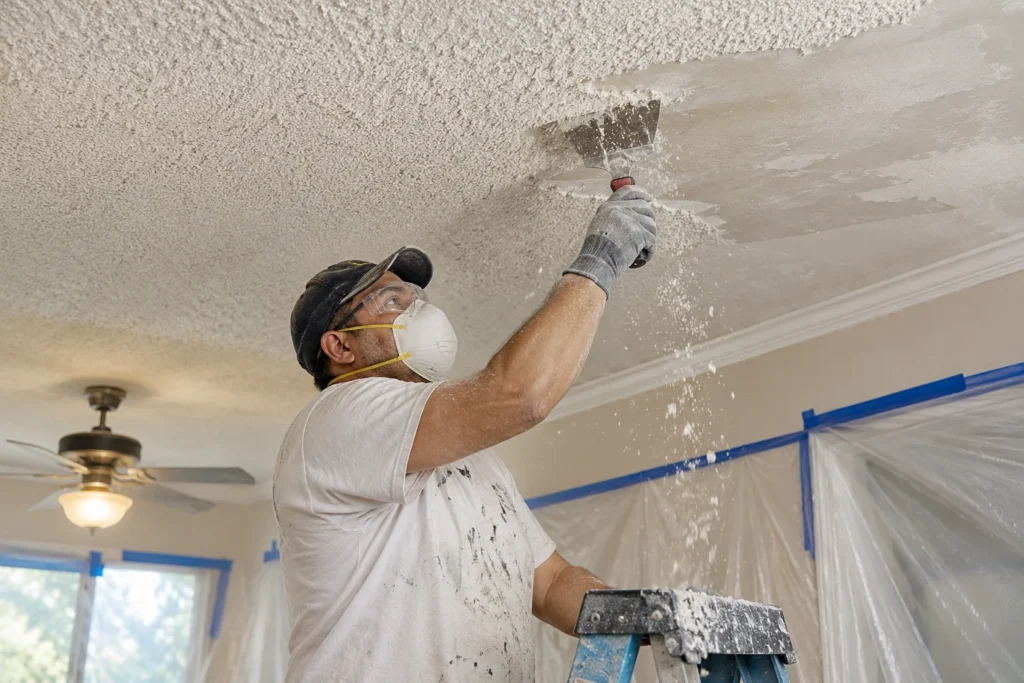
Short answer: Removing a popcorn ceiling is a sequence, not a single task. In general, the order is to look at the ceiling’s texture and condition, plan an asbestos evaluation before anyone disturbs suspect material, protect the room, remove the texture or choose another finish, repair or skim coat the surface as needed, then prime and paint. The step most homeowners skip is the first one: deciding what kind of ceiling you have and what has been done to it before. That decision shapes the scope of the whole project. This guide is for planning and decision-making, and it does not tell you how to remove a ceiling yourself.
If your Plano home has a textured ceiling and you are thinking about a smoother, brighter room, you are probably wondering where the project starts and what it involves. Popcorn texture was common in many older homes across Plano and the wider DFW area, and it is a frequent target in interior refreshes. This article walks through the decisions and the order of work so you can plan the project and ask better questions of a contractor.
Key Takeaways
- Treat ceiling work as a sequence: assess, evaluate for asbestos, protect, remove or replace the finish, repair, prime and paint.
- You generally cannot tell whether a material contains asbestos by looking at it, according to the EPA.
- Do not scrape, sand or otherwise disturb suspect texture before it has been evaluated.
- Ceiling condition, layers of paint, access and testing all affect the scope of the project.
- Smooth and updated textures are both valid choices. Pick the finish that fits the room and the condition of the surface.
- Plan room by room or for the whole home based on budget, disruption and how much the work overlaps.
What Should You Assess About the Ceiling First?
Before choosing a finish, find out what you are working with. A few questions help:
- What is the texture? Popcorn, knockdown, orange peel and others each behave differently.
- What is the condition? Look for stains, cracks, sagging, peeling or areas that have been patched before.
- How many layers of paint are on it? Texture that has been painted several times can behave differently from bare texture.
- Has water ever reached it? Stains may point to a past leak. The source should be understood before any cosmetic work.
- What is above and around it? Lighting, fans, vents and access panels all affect the work.
These are observations, not diagnoses. A contractor who sees the room in person can tell you more, and the answers feed directly into the scope. Heavier texture, more layers of paint or a prior repair can each change what the ceiling needs.
Do You Need to Test for Asbestos Before Removal?
This is the most important planning question on the list, and it deserves a careful answer. The EPA states that you generally cannot tell by looking whether a material contains asbestos, unless it is labeled, and that if you are unsure you should assume it might and avoid disturbing it. It says that undamaged materials that will not be disturbed do not need to be tested. It also warns that fibers can be released when material is disturbed, damaged or removed improperly, and it recommends that a trained and accredited asbestos professional take samples for analysis rather than doing it yourself (see EPA: Protect Your Family From Exposures to Asbestos).
Because looks alone cannot settle it, the sensible approach for a project that will disturb a textured ceiling is to plan an evaluation first. That is a planning point, not a rule about which ceilings are affected. Age is one factor people often mention, but it is not a reliable shortcut, and this article makes no claim about any group of homes. If a test result calls for specialist handling, that work belongs with a qualified specialist and not with a painter or a homeowner.
Requirements for testing and for disposal of materials can vary by jurisdiction. Check with the City of Plano or the relevant state agency about what applies to your project, and ask any contractor you speak with who handles evaluation and who handles any specialist work. Sonova’s team can talk through how your project would be sequenced, but you should confirm who evaluates suspect material and who handles it before the schedule is set.
What Does the Project Sequence Look Like?
The following steps describe the general order of a ceiling refresh. The details depend on your ceiling, your results and the contractor’s plan.
- Assessment. Review texture, condition, paint layers, moisture history and access.
- Asbestos evaluation, where appropriate. Plan it before anyone disturbs suspect material, and wait for the results before choosing a method.
- Room protection. Cover or remove furniture, protect floors, and cover vents and fixtures. Ceiling work is messy by nature.
- Removal or alternate finish. Depending on the findings, the texture is removed, or a different finish is chosen and applied.
- Repair and skim coat. Cracks, seams, patches and damaged areas are repaired. A skim coat may be used to create a smooth, even surface.
- Prime. Primer prepares the surface so paint goes on evenly.
- Paint. Ceiling paint is applied, usually after the surface has been checked in side light.
- Cleanup and walk-through. The room is cleaned and the finish reviewed.
Skipping or rushing any step shows up in the final result. If you want to understand why surface preparation matters so much, see our article on why sanding drywall matters. That article is about walls, but the principle applies: paint can only look as smooth as the surface under it.
Smooth or Updated Texture: How Do You Choose?
Removing the texture entirely is not the only option. Compare the choices on your own priorities.
| Option | What it is | Points to weigh |
|---|---|---|
| Smooth ceiling | Texture removed, surface repaired and skim coated, then primed and painted | Clean, modern look. Shows flaws in side light, so surface prep matters. Scope depends on condition and testing. |
| Updated texture | A lighter or different texture applied over a prepared surface | Can hide minor imperfections. A different look from smooth. Surface still needs to be sound. |
| Leave and paint | Existing texture cleaned and repainted | Least disruptive when the surface is sound. Keeps the existing look. |
| Cover with another material | A new ceiling surface installed | Can suit damaged ceilings. Changes scope, height and details. |
No option is right for every house. Smooth ceilings suit rooms with modern finishes and good lighting. Updated texture can work when the surface has minor flaws. Leaving the texture and repainting is a fair choice when budget or disruption is the priority.
Should You Do One Room or the Whole House?
Both approaches work. Which one fits depends on the household.
- Room by room. Spreads the disruption and can fit a phased budget. The risk is mismatch: if some rooms are smooth and others are not, the transitions need planning.
- Whole home. Often more efficient for protection and setup, and gives a consistent result. It means more disruption at once, and you may need to plan where to be during the work.
- Hybrid. Start with the rooms you use most, and plan the rest for later.
Think about adjacent surfaces as well. New ceiling paint can make wall color look different, and a smooth ceiling can reveal imperfections you did not notice before. Many homeowners combine ceiling work with wall painting or another interior update. Sonova’s painting page covers interior and exterior painting, and the remodeling page describes projects from individual room updates to larger renovations. Our guide on how to plan a remodel in Plano is a good next step if your ceiling project is part of something bigger.
What Affects the Scope and Price of a Ceiling Project?
We do not publish prices here, because every ceiling is different and any figure would be a guess. The factors that generally move the scope are:
- The texture type and how heavy it is
- The number of paint layers on top of it
- The condition of the underlying surface
- Whether testing is needed, and what the results show
- How much of the room needs to be protected or cleared
- Access, ceiling height and fixtures
- The finish you choose
- The number of rooms and how they connect
Ask for a written scope that lists these items so you can compare estimates fairly. If one estimate omits testing or surface repair and another includes them, they are not describing the same project.
What Should You Ask a Contractor?
- Who evaluates the existing texture, and who would handle any specialist work?
- What is the plan if a test result calls for special handling?
- How will the room and the rest of the house be protected?
- What finish steps are included: repair, skim coat, primer and paint?
- How will the surface be checked before painting?
- What is not included in the estimate?
Frequently Asked Questions
Can I tell by looking whether my popcorn ceiling has asbestos?
No. The EPA says you generally cannot tell by looking. Ask a trained and accredited professional about sampling rather than scraping it yourself.
Do I have to remove the texture to repaint?
No. Repainting in place is a valid option when the surface is sound. Removal is a choice that depends on the look you want and the ceiling’s condition.
Does Sonova Construction perform asbestos testing or abatement?
Please call to ask about the approach for your project. Testing and any specialist handling should be arranged with a qualified professional.
Ready to Plan a Ceiling Refresh?
If you are weighing a ceiling update in Plano or North Dallas, Sonova Construction can talk through your room, your goals and the order of work. Contact us here or call 972-777-3727.